Thursday, March 19, 2009

"Twitter"ing away (part III)


Twitter has taken the lead from Digg in as far as micro-blogging and crowd sourced news and networking content is concerned. Interestingly, users of Digg and Twitter save the view that Twitter scores over Digg in terms of user control i.e the user controls his "following" list and is therefore able to screen the content in the way he likes. Thus the elements of social networking are more relevant in Twitter. Digg however is crowd sourcing to the core and is an open platform to voice views, opinions,suggestions etc. The user cannot regulate the flow of information and the source of the information. Thus Twitter is also relevant as apowerful relation marketing tool. (at the cost of loosing out on a pure crowd sourcing platform)

However the popularity of Twitter is based in a fact deeper than the celebrity usages and formidable following (of Techno Blogger, News and Broadcasting Corporations and Social networkers). As a social platform, Twitter is unique in terms of its API (application programming interface), which allows its access from variety of platforms. As stated earlier, Twitter is accessed from computers and the web only in 56% of the cases. Its API gives it the versatility to be accessed from IM platforms, Twhirl: its desktop client, TXT: the SMS based medium, Twitterific: its iPhone based interface and a whole host of other platforms.
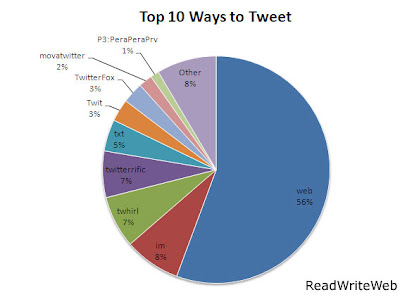
Clever Read Write Web research estimates of the traffic source to twitter

Thus it is Twitter's applications from their API that is making them grow rapidly. This enhances the ability of the user to  "tweet" from anywhere by simply using the mobile phone as the medium. By using the power of mobile phones, Twitter is integrating the user who may not be instantly connected to the internet to connect to twitter. There lies Twitter's biggest strenght. Not that this strenght will not be replicable, but the first use of this medium has propelled Twitter to this position. Its user base has gone up by a multiple of 8 and is increase 60% MOM even as i write this blog.

Ironically however, the API which is so versatile in terms of access is and may not be the most stable for third party application hosting if it comes to monetizing the user base.There in,Twitter has a huge challenge of converting its API into a serious platform if it is to grow into a mainstream application.

"Twitter"ing away (Part II)

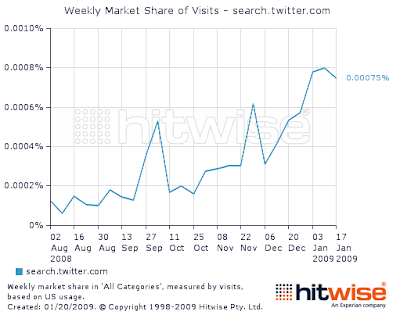
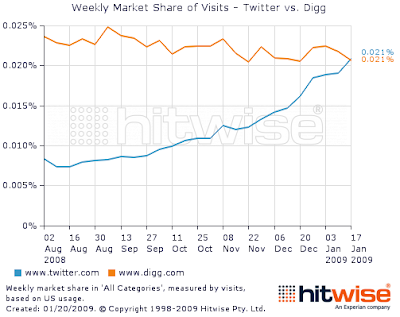
On January 17th,2009, Twitter beat Digg as the most popular pastime for people who like to update their thoughts and activities and voyeurs who enjoyed reading about people's lives. The surge in volumes came when the crash of US airways flight 1549 was tweeted by Janis Krums. Krum became a celebrity, Tweeter a phenomenon and the site visit hits one of the largest for any events around the world. It also peaked during President Obama's swearing in on January 20th, 2009. Not only is it now associated with micro blogging but there are strong refernces to its use as a tool for citizen journalism and the emergence of crowdsourcing news and updates.


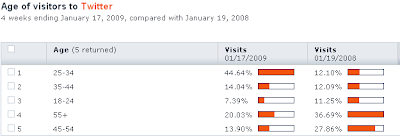
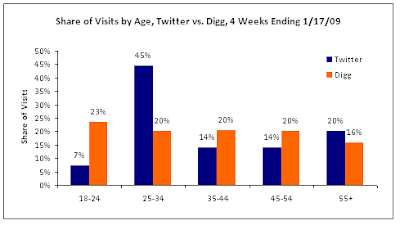
The increase in Twitter's base of followers/users/Tweeters has gained maximum audience from the 25-34 group. The Numbers in other age brackets have also seen huge numerical increases, though the percentage contributions have definitely tilted towards the younger lot. See the chart below.

Twitter's age distribution pattern in heavy towards the 25-34 age group. For Digg, it is mostly uniform across the age bands.


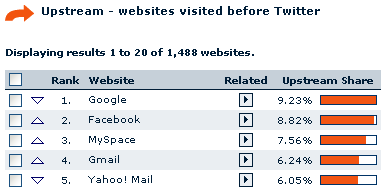
Also relevant are the clickstream data according to which, Digg relies heavily on Search sites such as Google for traffic. (The absolute number of Searches for Twitter is still higher than Digg). On the other hand Twitter recieves higher share of traffic from social networks. This is mostly due sto the applications which integrate these sites. For instance, Twitter application has 104,000 users on Facebook, where status updates can be linked to Twitter!

One dampener to these statistics is the fact that Twitter's traffic is routed through a variety of sources. In fact 44% of its traffic are from sources which are not web based. This includes the text message, Instant message, RSS and Twitterific applications. A significant amount of Twitter activity takes place through mobile phones, which is not measured and which could impact the Twitter statistics in a northward fashion. So the web based numbers actually tell a part of the story, the whole of which can only be guessimated by the buzz around Twitter during the Barack Obama's Presidential Campaigns and Swearing in.

VAS: Increasing Penetration and Revenue

Covering a Linked in Discussion, on Increasing penetration and revenue of VAS services in India.

How to Increase penetrations and Revenue for various VAS services?
Given the present scenario, getting a bigger wallet share for VAS services from the consumer seems to be the biggest hurdle? How can the consumer be incited to use various new VAS services that come up? Is tariff discounting or offering Free Try n Buy the only way to let the consumer have a feel of the service?? 


Hi Anoop 

Your Q seems to have generated a healthy round of discussion and here is my take adding to the muddle 

I come from a Marketing related view guided by two basic tenets 

1. Supply and Demand 

Music, H/Bollywood, Games, Ringtones, Singtones, Cricket is what most of the VAS revenue is based up on (Currently). There is a healthy demand for this but supply is manifold leading to commoditization. Hence the need for innovation in VAS! (Think Medicine, Think Train Ticketing/ Think Fitness/ keep thinking..) 

2. The Age old Construct of the 4Ps. 
We have a Product/Service and currently we are trying to push mass usage through Tariff discounting (Pricing Strategy). A few Opinions beforehand have already mentioned Retail Push (Place) and Cross Selling/Up selling and Consumer Education(Promotions). Even more, we have spoken about Profile and Behavioural based Targetting (a very high order mechanism) 

My take on the VAS markets in India : 

1. We need more stakeholders in the ecosystem. Currently it is only the VAS provider and the Operator. Hence the scope in VAS development and deployment remains limited. 

2. The Indian Consumer is averse to Credit Card and Mobile Payments. I am not surprised about VAS ARPU of Rs.25 (as cited by Rahul). 

3. We are limited in content.Games + Music + Entertainment form 36% of VAS applications in US. The next 36% is Books, Utilities, Education, Lifestyle, Productivity, Travel, Fitness, Sports etc. Social Networking as VAS content has also been less exploited. 

Point 1,2,3 (More Stakeholders, Wider content, Paying Mechanisms) lead me to the end of my argument, which i will elucidate with an example: 

How about partnering with VLCC for beauty tips, reserving apointments, reminders etc etc? 
How about partnering with Apollo hospitals to provide a range of services on a VAS platform? 
Tie ups with Local Gyms to disburse mobile services to its members? 
Taxi services and Train/Flight Booking via VAS.... 
The possibilities are endless if you take the unconventional route to VAS and application monetization.The business model would be a win win win design for the consumer - Telco + VAS - Solution provider. 

Would consumers pay? They already do... and a minor addition in terms of taking services mobile will not hurt them if they are hung up on VLCC, Apollo and the likes... 

End points: 
1. Dont invent new needs and delivery mediums, instead tap the consumer needs at the right places and occasions 
2. There is a fundamental need to move away from Telco VAS provider (Duopoly mindset) to a tag along/second fiddle mindset with the solution provider. 

Hope this is somewhat leading to the right direction. 

"Twitter"ing away (Part I)


Twitter has got more than its share of media coverage (if you compare it vis a vis other bigger sites like Yahoo, AOL and others. In fact if one were to create an index of the media versus the size/user base, Twitter would probably beat Facebook and Google at the indices.)

  • Twitter is being used by News and Broadcating Corporations like BBC, CNN, New York Times, Wall Street Journal and others.
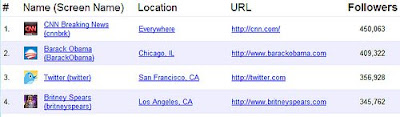
  • The celebrity usage of Twitter is phenomenal. It starts with Barrack Obama's presidential campaign, to Lance Armstrong, Stephen Fry, Britney Spears and loads more.
  • It created waves when the Janis Crums twittered the US airways flight 1549 crash at Hudson from his iPhone. (Coverage)
  • Twitter was forever on news regarding its $35 million venture capital funding from Institutional Venture Partners and Benchmark Capital. (Read News)
  • Tech blogs such as Tech Crunch and social networking blogs such as Mashable heavily tweet through this medium.
  • Firsthand Reports from California wildfires poured through Twitter in front of media and news agencies. (read Report)
Twitter now is world's most popular micro blogging platform, a compelling social service and very soon to be a mainstream channel.It upstaged fellow rivals and web 2.0 rivals such as Digg, Flickr, Delicious in terms of Google Search querries (as reported by Google Trends). The indication here is the first time usage would have been impacted in this manner. (First time users use Search engines to locate the services). Thus presumably, more people are joining twitter than its rivals.

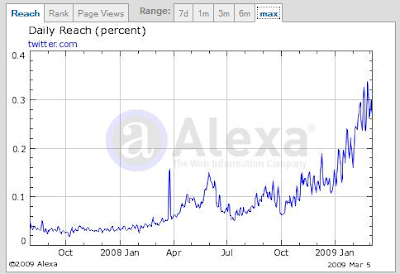
Alexa Ranks also indicatesthat its reach has grown 6 times over in one and a half years (from .05% in October 2007 to .32% in Febraury 2009). Its page rank has improved from 4309 in October 2007 to 233 currently.
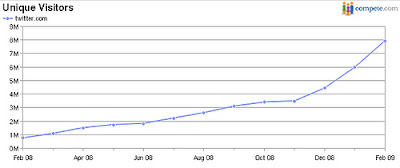
According to Compete, Twitter’s month-to-month change is an upward trend of 32.7% whereas for the year-to-year change, it’s 964.5%. For the month of February, it states that it has 8 million unique visitors using the platform
Quantcast, a service that only tracks websites based on the number of US people who have visited them, Twitter was ranked #163 and its monthly US people has reached 6.1 million, a 600% boost from August last year. Other stats include US Demographics of which 47% and 53% are male and female group respectively. Also, the main bulk comes from the 18-34 age group.
Real time, Twitter user and client statistics, shows that an average of 2 million tweets are posted by users on a daily basis. AN indication of the success of Twitter is the Twitterholic, which indicates the folowwings per user. These numbers have gone up dramatically over the past year and half. An example in question is CNN which had a 1000 daily visitors now has 10000 visitors per day.


The growth has been dizzying and from the looks of it, Twitter has caught the eye of technology geeks, Technology Cos (Facebook, Google, Microsoft). The growth doesnot seem like it is going to slow down any sooner. 

Wednesday, March 18, 2009

Daily addiction:Mobile Internet

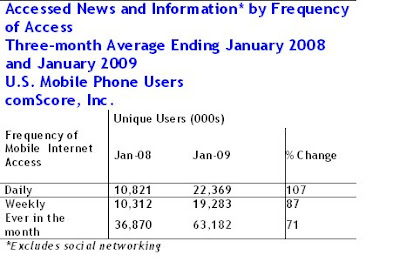
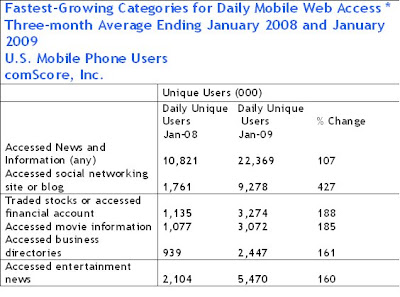
A recent study by comScore has now revealed that the number of people browsing internet through their mobile devices has doubled through January 2008 - January 2009. With job cuts, and current economic crisis in the background, mobile communication has gained acceptance as a cheaper, more accessible, convenient and more secure conduit to browsing the internet. Mobile internet has thus evolved from an occassional activity to a part of people's daily lives and routines. Among the audience of 63.2 million peopleaccessed news and information on their mobile devices within the studied time frame, 22.4 million – or 35 percent – did so on a daily basis. This number represents more than a 100 percent jump from the size of the audience the year before. 

Social networking and blogging emerged as the most popular daily uses of the mobile web access. It registered a 427% jump in traffic (January 2009 versus January 2008). News sites registered a growth of 188% and entertainment sites registered 107% growth in mobile web access.

In terms of applications, News related apps saw 22.3 million traffic, while search related apps registered 14.1 million users. Maps was popular amongst 8.2 million users. Overall, 32.4 million people used SMS to access news and information.

Tuesday, March 17, 2009

Of Wallet Phones and Mobile Payments


Wallet phones are mobile phones equiped to include bank cards, credit cards, house keys, company access control IDs, electronic cash, train tickets and many more functions. Wallet phones in principle can take over all functions which our wallet has.Wallet phones enable mobile operators to enter new industries, especially the payment and credit card industries. For this reason wallet phones represent innovation and disruption for established industries, such as credit cards.

Payments through mobile phones is a fundamental shift of paradigm occuring in the wireless communication industry. It originated in Japan. Due to declining ARPU Japanese mobile operators are creating new streams of income independent of voice or data traffic. This paradigm shift led DoCoMo to invest in financial institutions, create a credit brand, and make a series of other investments including brick-and-mortar business, while competing operators follow different strategies.

The NFC (near Field Communications) technology has been there on the horizon for sometime now. Currently, local mPayment transactions, also known as proximity mPayments or Near Field Communication (NFC), do not have much scope as only 1 percent of mobiles sold in 2008 were allegedly NFC-enabled and there is no widespread, popular recipient technology to complete an NFC payment. NFC is a technology that enables devices to wirelessly exchange data without physical contact within a range of 4 inches. It eliminates the need for all types of plastic transaction cards and, therefore, contributes towards saving the environment. It works in the 13.56 MHz radio frequency band, has a bandwidth of 2 MHz and can support 848 kbits per second exchange of data.

However, 2008 turned out to be the first big year of reckoning. In 2008, approximately $72 billion mobile initiated business was accrued via an estimated 25 billion transactions made by nearly 40 million consumers, which included roughly $24 billion for purchasing games, music and ringtones. 18% of US households wired to the internet have made sometype of mobile payment in 2008 including online bill payment, money transfers to individuals, online loan payments and online purchases. 

A new analysis by Juniper Research in mobile payments opportunity forecasts that, by 2013, the figures could jump exponentially to $860 billion generated made by close to 450 million consumers with 285 billion transactions, dedicated towards the purchase of physical goods (typically gifts and books) and services other than mobile content on- demand/digital goods (such as music, tickets and games). mMoneyTransfer is expected to generate more than $200 billion in 2013.

Highlights from the report include:

• Global annual gross transaction value will grow over 5 times by 2013

• The ticketing segment will be driven by consumer usage on rail, air and bus networks as well as sports and entertainment events This will represent over 40% of the global transaction value by 2013

• The top 2 regions (Far East and W. Europe) will represent over 60% of the $300bn p.a. global mobile payment gross transaction value by 2013 for digital and physical goods. Western Europe is currently dominated by digital goods and services sold via SMS, whereas the Far East & China region (specifically Japan) is already well established in physical goods sales over the mobile web, and has been for a number of years.

Informa estimates that by 2013 more than 10 percent of all mobiles in use will be NFC- enabled, technology support to receive NFC payment will be common, and these factors should facilitate close to 180 million users to pay restaurant bills, buy tickets, pay toll fees, and buy groceries, apparel and home equipment.

In 2008, only 67 million mobile phone users accessed mBanking services, whereas in 2013 the figure could reach one billion.
Amongst banks, mobile manufacturers and technology vendors, the buzz about Mobile payments is discernable. Recently Visa (the world's largest electronic payments network), demonstrated its mobile payment solution at Dubai. With a network across 170 countries, it will not be too long before Visa takes the mobile payments technology to the mass.
The stumbling block in large scale adaption would do with threat perception of transaction security. An NFC survey by ABI research indicates the transaction security to be the concern amongst users. It is only a little time and the convenience factor, which will sway the users towards use of the m-Payment platform. 

Monday, March 16, 2009

Enter Google Voice

You can often find me saying in exasperation... "there's Internet and there is Google!". It appears that the Mountain View based giant is not satisfied with its Search Stardom and wants to protract the internet technologies to disrupt other industries around the world. Google Voice, though in its infancy has the power to blow away the existing rules of the Telecom game and i daresay, that carriers and operators throughout the world are hawk eyeing Google's moves. 

First there was Google Latitude that made its debut in January 2009 and now is the turn of Google Voice. Both services combined together would serve as a full scale solution to networking, voice and data needs of people around. (Imagine yourself beaming a picture of a new dress that you would like to buy for your daughter to your wife for her approval. You are in New York and she in London or any other part of the world). That scenario with Google can give cold sweat to many other companies around who have stakes in Telecom, Voice, Data and auxilliary services.

Google, signaled what would be the next telecom technology disruption on 13th March 2009 (Read here). Within 5 days, there are half a million blog posts dedicated to Google Voice. Check them here. As i had said, in one of my earlier posts, the art of maintaining Relevance comes very naturally to Google.

Bought in 2007, Grandcentral is reincarnated as Google Voice in 2009, with a few polishes and additions. Essentially a VoIP based network, a user is given an account and a 10 digit phone number, except that there is no phone at the end of this number. Instead the user has to log onto his account and "manage" his calls. He has to specify where the calls need to go i.e either his mobile or his residence number or his voice mail etc. One can also program it such that business calls are routed to office number till 5 O clock and then go to voice mail system directly. So this becomes a single portal of managing all communicational priorities. It can also be managed for customizable features, call screening and controls and solution et all. That is the core of the technology! Out side this, there are features such as 
  • Automated voicemail transcriptions — Users have the option to receive free transcriptions of all their voicemail messages.  These transcriptions are fully automated (i.e. no human listens to the voicemail), and are searchable within your Google Voice inbox.
  • SMS messaging — Receive SMS text messages sent to your Google Voice phone number on your mobile device and on the web.  Send and reply to text messages directly from your phone or your Google Voice inbox.
  • Conference calling — If you’re on the phone and receive an incoming call, you now have the option to merge your calls.  Have as many as six people join a single call.
  • International calling — Place international calls at reasonable rates from your phone or by using the QuickCall button in your Google Voice inbox.  Purchase credit using Google Checkout and pay by-the-minute for international calls.
Read the complete feature lists here

Google Voice is available in its Private Beta option to users of the Grandcentral. With this now, Google is subverting the rules of the game by offering free speech to text messages, Free conferencing, almost free VoIP calls, Reduced International calling rates, and a link up with Gmail. All this is in effect, game changing!

There are the usual and relevant concerns with issues of privacy and the individual exposing himself to a ubiquitous company to such a large degree.The huge increase in personal content handled by one company that excels in mining such data paves a dangerous and rocky road to serious privacy issues.

Google is clearly sending another message to the rest of the telco's and wanna be telco's that Google is not happy with merely being the top of the pile in search and all things on the internet, but that it really plans to take over the communications world as well. Based on previous successes I wouldn't put it past them!