Showing posts with label Mobile Internet. Show all posts

Monday, August 10, 2009

Why HTML 5 is important for mobile development

Reproducing a Blog from Jason Grisby, VP Mobile and Web Strategist, Cloud Four on the emergence of HTML 5 as the future in Mobile Development, over running Microsoft (Which according to him has no mobile strategy) and Blackberry as the competing startegy.

Ref: http://technologyandtelecom.blogspot.com/2009/08/heres-looking-at-you-html50_03.html; http://technologyandtelecom.blogspot.com/2009/08/heres-looking-at-you-html5.html; http://technologyandtelecom.blogspot.com/2009/08/heres-looking-at-you-html50.html


With the effective cancellation of the W3C's XHTML2 project, HTML 5 emerges as the foundation for future Web development.

And, under the pressure of mobile Web development, it will very quickly become very important, says Jason Grigsby, Vice President, Mobile and Web Strategist, at Cloud Four, a Portland, Oregon Web and application development shop.

In a blogpost today, Grigsby writes "At the risk of being accused of wearing mobile-tinted glasses,HTML5 is going to big a deal and it will be relevant much sooner than people think."

That's because, Grigsby says, HTML 5 provides a range of key capabilities that mobile developers targeting the new breed of Web browser will enthusiastically embrace. The key HTML 5 features include: offline support, via the AppCache and Database APIs for storing stuff locally on the device; Canvas and Video to simplify adding graphics and video to a page while ignoring plugins; advanced forms, which can handle tasks like field validation on the mobile browser; and the GeoLocation API, which Grigsby points out is not actually part of HTML 5 but often crops on phones that are supporting HTML 5.

Not being a developer myself, I've been aware of the XHTML2 controversy but haven't followed it closely. Grigsby has a serveal links to sites which go deep into the merits of both standards.

But his more technically more fluent post, with the added insight of actually being a code writer, reflects the basic theme of of our recent coverage: that the most modern browsers, many based on the Webkit engine, coupled with HTML 5 support, offer a very simple to use platform for building very sophisticated mobile Web applications. The same basic technologies in fact are being embedded in both Palm's webOS and Google's just-announced Chrome OS for exactly those same reasons.

The two key players in the HTML 5 development are the W3C's HTML Working Group and the Web Hypertext Application Technology Working Group (WHATWG). That latter was specifically formed to develop HTML and APIs for Web application development.

Grigsby says that's an important emphasis, one that seems at least for now somewhat orthogonal to the debate over the current HTML 5 shortcomings, principally it's lack of extensibility. While important, that's less of an issue for mobile application developers, if I read him correctly.

He also counters those who argue HTML 5 is irrelevant for the moment because it's not supported by Microsoft Internet Explorer, Grigsby argues it's that very fact that means mobile will drive HTML 5 adoption: "The iPhone, Google Android, Nokia, and the Palm Pre are all based on the open sourceWebkit browser engine. Those phones represent somewhere around 65% of smart phones sold."

It's not clear, he argues, that Microsoft even has a viable mobile strategy, since it's principal Windows Mobile implementer, HTC, has publicly indicated it expects the Android OS to be on half of all the mobile phones it ships in 2010. UPDATE: Jason tells me that the HTC move is rumored, not a fact.

The real obstacle to HTML 5, Grigsby says, somewhat surprising is RIM's BlackBerry OS, with its companion proprietary Web browser. But for both platforms, he notes, Opera's browser is available for download. "And Opera is one of the leading developers of HTML5."

Monday, August 3, 2009

Heres looking at you: HTML5.0

Continued from earlier posts
http://technologyandtelecom.blogspot.com/2009/08/heres-looking-at-you-html5.html
http://technologyandtelecom.blogspot.com/2009/08/heres-looking-at-you-html50.html
The Pressing Need for HTML5 is More Features

HTML5 needs to move past simply providing geo-location and offline storage and into more of the device characteristics. The Palm Pre’s WebOS had to forge forward in defining its own APIs for accessing things like the address book, camera, and accelerometer.
This problem is only going to continue to become more pressing. People are clamoring to develop mobile applications that take full advantage of the capabilities of devices.

Smart Phones Do Not Equal All Phones

It is important to note that while HTML5 will be very important for smart phones, it won’t reach feature phones for sometime. Therefore, content publishers should continue to work with device databases for content adaptation.
Again, web application developers can make different choices and tradeoffs than content publishers. If one is building an application that combines cameras with geo-location information, one has already narrowed which handsets you support.

Features will Drive HTML5 Adoption

One can take a learning from moving users from HTML working drafts to HTML 3.2.A large part of it is due to the fact that you could do things in HTML3.2 that you couldn’t do in previous versions.
That’s not to say that recent web standards like XHTML haven’t provided new features, but that none of the new features were game changers. Geo-Location is a feature that can create businesses. The same is true of access to other device characteristics.
For this reason, web developers who start looking at mobile development will not shy away from building using HTML5 even if it limits their audience.

The Mobile Perspective on HTML5

From a mobile perspective—and perhaps from the perspective of web applications generally—HTML5 cannot come quickly enough.
As Vic Gundotra, Google Engineering vice president and developer evangelist, recently pointed out, not many companies are rich enough to develop native applications for all mobile platforms.
The mobile web provides are the best hope for building a cross-device mobile ecosystem. HTML5 is a critical piece for the mobile web.

Here's looking at you: HTML5

Continued from earlier post: http://ronnie05.wordpress.com/2009/08/03/vvlj/


Lack of Extensibility

One of the new things HTML 5 sets out to do is to provide web developers with a standardized set of semantic page layout structures. However, the new elements may not be entirely forward-compatible, as they are constrained to today’s understanding of what makes up a page. An extensible mechanism, although less straightforward, would offer more room to grow as the web evolves.HTML5 does add new elements like header, nav, article, section, aside, and footer which expand the structural definition of a page, but does not provide the level of extensibility that people have been seeking.

Documents versus Applications:

From a future perspective, HTML5 is seen as a document publishing, however, in its present avatar it is painfully evident that it lacks the tools it needs to describe the documents sufficiently.

There is also a burning need to address the short-comings of HTML for web applications —especially when it comes to being able to build rich web applications for mobile devices.

While most of the smartphones in the world use the Webkit in some form or the other and HTML 5 will have to build upon this platform as a base, it is worth bringing to notice that Webkit Does Not Equal HTML5 Support… Yet

To be clear, just because a device uses webkit does not mean that it has the latest version of Webkit and can use HTML5. Recognizing the market share of Webkit is important solely as an indicator that a significant portion of smart phones will have access to HTML5 sometime in the near future.

There is great incentive for mobile operating system vendors to upgrade to the latest versions of Webkit. They see the success that the iPhone has had and the fact that one of the main contributors to that success was the browsing experience. They understand that not many companies can afford to develop native applications for all of the various platforms which makes the features of HTML5 attractive.

Because of this, expect browser improvements are a high priority for mobile operating systems.

Here's looking at you: HTML5.0

World Wide Web Consortium’s decision to not renew the XHTML 2 Working Group charter effectively means that XHTML 2 (as a web standard) is effectively dead. In its place as the future of web development stands HTML5.

Given the emergence of "mobile internet" as the next revolution in internet medium, HTML5 is going to big a deal and it will be relevant much sooner than people think. Adoption of HTML5 will be driven by the needs of mobile, not the needs of desktop developers.

When Can We Use HTML5?
HTML5 did not really matter until IE supported whatever new standard for mobiles or IE no longer has the majority of the market share.

Given the fact that IE doesnot have a mobile bias, the smartphone growth will drive HTML5 adoption. The iPhone, Google Android, Nokia, and the Palm Pre are all based on the open source Webkit browser engine. Those phones represent somewhere around 65% of smart phones sold.If you look past mobile phones to other mobile devices like the iPod Touch, Nokia’s internet devices, and the upcoming Google Chrome, you see that Webkit is even more broadly distributed.

The two major platforms not using Webkit are Windows Mobile and Blackberry. Some of the capabilities of HTML5 are available to Windows Mobile users via the Google Gears plugin.
Blackberry has its own specialized browser not built on any of the major browser engines. It only recently started handling html, css and javascript reasonably well, but still is insufficient and buggy compared to other browsers.

Fortunately, for both Windows Mobile and Blackberry, Opera’s browser is both available and popular. It is consistently one of the top if not the top download on mobile applications sites. And Opera is one of the leading developers of HTML5.

HTML5 for Mobile
HTML5 is a critical step for mobile web application development. Some of the key elements that it provides are:


  1. Offline Support — The AppCache and Database make it possible for mobile developers to store thing locally on the device and now that interruptions in connectivity will not affect the ability for someone to get their work done.

  2. Canvas and Video — These two features are designed to make it easy to add graphics and video to a page without worrying about plugins. When supported by the phone’s hardware, as is the case with the iPhone, they provide a powerful ways to get media into a page.

  3. GeoLocation API — This is actually not part of HTML5, but is a separate specification. That said, it is often bundled together because the mobile phones that are including HTML5 are generally supporting the GeoLocation API.

  4. Advanced Forms — Even simple things like the improvements in HTML5 for forms could make life easier for mobile applications. Fields that can be validated by the browser are improvements for mobile devices. The more that can be handled by the browser means less time downloading javascript code and less round trips to the server if validation can be found before the form is posted.

  5. Most importantly, nearly all of the hybrid applications frameworks—Phone Gap, QuickConnect, RhoMobile, Titanium Mobile, and others—rely on HTML5 features to provide a rich application experience.

Thursday, April 2, 2009

Providing better mobile browing experience

(Been off for a while now on a vacation and other work. This is my first post after 10 days and concerns mobile internet experience.)

One of my earlier posts covered the proliferation of mobile devices as the window to internet to an increasing number of people around the world. http://technologyandtelecom.blogspot.com/2009/03/daily-addictionmobile-internet.html
This covered the stats and the emerging trends in mobile internet. As a mobile internet user, my experience with mobiles has been very frequent although the quality of experience is certainly not the best. Data transfer speeds in India are not all that great and 3G is still some way off. However, one other aspect where i face a problem in terms of usage experience of mobile internet, is page loading. This has to do with cookies, frames and other technical aspects which in general make a broadband experience great but a mobile experience relatively weak. Certain sections of pages dont load and this is especially true for commercial/business driven/business sites. Try booking a train/flight ticket from your mobile to experience the problems and hitches.

The question that i had posed to an open group of experts/commentators of Web 2.0 (a Linkedin group) was: How can websites be customized for a better mobile device based browsing experience?

I had a fairly wide range of answers, which i am documenting in this blog post in the form of views. It is necessary to realise that these views may not be mutually exclusive thoughts, in fact, they are quite inter-related to each other at various parts of the delivery chain.

1. View 1: The most popular answer (referred by Lee Curtis / George Lehman /Rachin Kapoor) that emerged from a web developers perspective was the use of CSS styled xHTML, a tool that semantically describes presentation lay outs separately from the content. CSS is useful in presenting the fully loaded site on a lap top/desk top, where as the HTML presents a small aand effective, quick loading and light mechanism for mobile phones. Thus the accessibility features are customised according to the screen and the device and streamlines site indexing more effectively.
(View 1 extended by Kabari Hendrick/ Nial Kennedy) While websites use the CSS/xHTML tools, user agent determination techniques travel from the cloud/net to the access window and determine the agent and direct the CSS/xHTML for suitability of the download (in terms of Lite or Heavy). This happens within a very short interval and doesnot extend the download time significantly.

2. View 2: While view 1, is about back end web site compatibility with device, the second view (by Andy Foote and Vincent Graux), is about how hardware evolution is taking care of the fundamental resstiction of a small screen, by creating larger and richer interfaces. The case in point being netbooks, which were born out of the fusion of browsing experience and mobility.

The analogy here is creation of a bridge across a chasm. One side (devices) is starting to build smaller and mobility centric devices to bridge the chasm. The other side (website / internet / programming) is trying to do the same by customizing the presentation formats on the websites.

View 3: While the earlier views were hardware and software based, this view, forwarded by Jim Vezina , Poorna Kedar and Gianluiggi Cuccureddu is business focussed and thus the most relevant. This advocates, the understanding of web traffic i.e the reason why people would visit some website. Thus having identified the raison d' etre of the website, the experience has to be tailored. For example a website, which is e-commerce led, should see to it that the payment portals are easy to load and secure and provide the relevant user experience without getting into elaborate frames and pages etc as far as a mobile experience is concerned. A lap top experience can be the full monty as it is. A mailing site, needs to see to it that the mobile experience includes written text content provided to the user without too many buttons, frames and others. A social networking site probably needs to go a little bit more in terms of pictures and videos and nothing else. This can be done through the standard View 1 and View 2 tools as described earlier. Or further yet, if required, have two different web sites, one for regular users and the other for mobile users if your traffic is so profiled ( Rick Dane)!

Other contributors: John Rodrigues, Dipak Dave, Wallace Jackson

Wednesday, March 18, 2009

Daily addiction:Mobile Internet

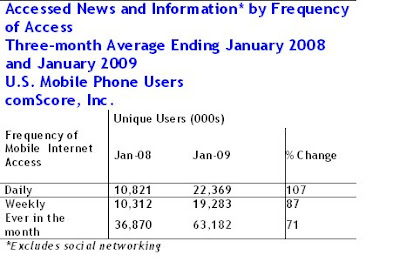
A recent study by comScore has now revealed that the number of people browsing internet through their mobile devices has doubled through January 2008 - January 2009. With job cuts, and current economic crisis in the background, mobile communication has gained acceptance as a cheaper, more accessible, convenient and more secure conduit to browsing the internet. Mobile internet has thus evolved from an occassional activity to a part of people's daily lives and routines. Among the audience of 63.2 million peopleaccessed news and information on their mobile devices within the studied time frame, 22.4 million – or 35 percent – did so on a daily basis. This number represents more than a 100 percent jump from the size of the audience the year before. 

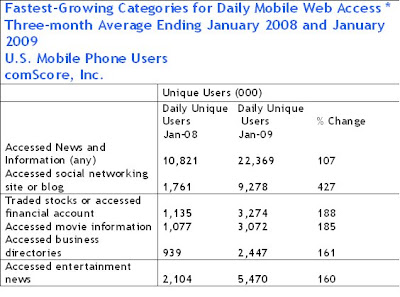
Social networking and blogging emerged as the most popular daily uses of the mobile web access. It registered a 427% jump in traffic (January 2009 versus January 2008). News sites registered a growth of 188% and entertainment sites registered 107% growth in mobile web access.

In terms of applications, News related apps saw 22.3 million traffic, while search related apps registered 14.1 million users. Maps was popular amongst 8.2 million users. Overall, 32.4 million people used SMS to access news and information.