Wednesday, March 18, 2009

Daily addiction:Mobile Internet

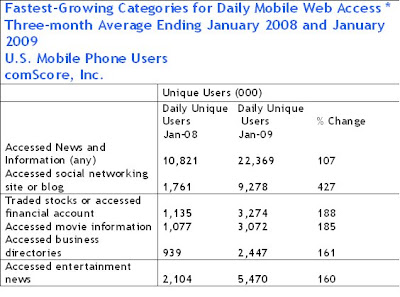
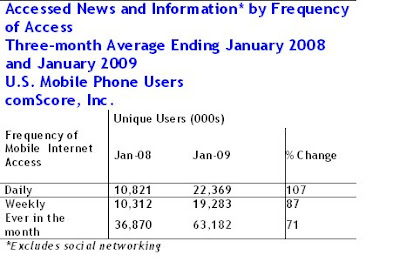
A recent study by comScore has now revealed that the number of people browsing internet through their mobile devices has doubled through January 2008 - January 2009. With job cuts, and current economic crisis in the background, mobile communication has gained acceptance as a cheaper, more accessible, convenient and more secure conduit to browsing the internet. Mobile internet has thus evolved from an occassional activity to a part of people's daily lives and routines. Among the audience of 63.2 million peopleaccessed news and information on their mobile devices within the studied time frame, 22.4 million – or 35 percent – did so on a daily basis. This number represents more than a 100 percent jump from the size of the audience the year before. 

Social networking and blogging emerged as the most popular daily uses of the mobile web access. It registered a 427% jump in traffic (January 2009 versus January 2008). News sites registered a growth of 188% and entertainment sites registered 107% growth in mobile web access.

In terms of applications, News related apps saw 22.3 million traffic, while search related apps registered 14.1 million users. Maps was popular amongst 8.2 million users. Overall, 32.4 million people used SMS to access news and information.

Tuesday, March 17, 2009

Of Wallet Phones and Mobile Payments


Wallet phones are mobile phones equiped to include bank cards, credit cards, house keys, company access control IDs, electronic cash, train tickets and many more functions. Wallet phones in principle can take over all functions which our wallet has.Wallet phones enable mobile operators to enter new industries, especially the payment and credit card industries. For this reason wallet phones represent innovation and disruption for established industries, such as credit cards.

Payments through mobile phones is a fundamental shift of paradigm occuring in the wireless communication industry. It originated in Japan. Due to declining ARPU Japanese mobile operators are creating new streams of income independent of voice or data traffic. This paradigm shift led DoCoMo to invest in financial institutions, create a credit brand, and make a series of other investments including brick-and-mortar business, while competing operators follow different strategies.

The NFC (near Field Communications) technology has been there on the horizon for sometime now. Currently, local mPayment transactions, also known as proximity mPayments or Near Field Communication (NFC), do not have much scope as only 1 percent of mobiles sold in 2008 were allegedly NFC-enabled and there is no widespread, popular recipient technology to complete an NFC payment. NFC is a technology that enables devices to wirelessly exchange data without physical contact within a range of 4 inches. It eliminates the need for all types of plastic transaction cards and, therefore, contributes towards saving the environment. It works in the 13.56 MHz radio frequency band, has a bandwidth of 2 MHz and can support 848 kbits per second exchange of data.

However, 2008 turned out to be the first big year of reckoning. In 2008, approximately $72 billion mobile initiated business was accrued via an estimated 25 billion transactions made by nearly 40 million consumers, which included roughly $24 billion for purchasing games, music and ringtones. 18% of US households wired to the internet have made sometype of mobile payment in 2008 including online bill payment, money transfers to individuals, online loan payments and online purchases. 

A new analysis by Juniper Research in mobile payments opportunity forecasts that, by 2013, the figures could jump exponentially to $860 billion generated made by close to 450 million consumers with 285 billion transactions, dedicated towards the purchase of physical goods (typically gifts and books) and services other than mobile content on- demand/digital goods (such as music, tickets and games). mMoneyTransfer is expected to generate more than $200 billion in 2013.

Highlights from the report include:

• Global annual gross transaction value will grow over 5 times by 2013

• The ticketing segment will be driven by consumer usage on rail, air and bus networks as well as sports and entertainment events This will represent over 40% of the global transaction value by 2013

• The top 2 regions (Far East and W. Europe) will represent over 60% of the $300bn p.a. global mobile payment gross transaction value by 2013 for digital and physical goods. Western Europe is currently dominated by digital goods and services sold via SMS, whereas the Far East & China region (specifically Japan) is already well established in physical goods sales over the mobile web, and has been for a number of years.

Informa estimates that by 2013 more than 10 percent of all mobiles in use will be NFC- enabled, technology support to receive NFC payment will be common, and these factors should facilitate close to 180 million users to pay restaurant bills, buy tickets, pay toll fees, and buy groceries, apparel and home equipment.

In 2008, only 67 million mobile phone users accessed mBanking services, whereas in 2013 the figure could reach one billion.
Amongst banks, mobile manufacturers and technology vendors, the buzz about Mobile payments is discernable. Recently Visa (the world's largest electronic payments network), demonstrated its mobile payment solution at Dubai. With a network across 170 countries, it will not be too long before Visa takes the mobile payments technology to the mass.
The stumbling block in large scale adaption would do with threat perception of transaction security. An NFC survey by ABI research indicates the transaction security to be the concern amongst users. It is only a little time and the convenience factor, which will sway the users towards use of the m-Payment platform. 
Monday, March 16, 2009

Enter Google Voice

You can often find me saying in exasperation... "there's Internet and there is Google!". It appears that the Mountain View based giant is not satisfied with its Search Stardom and wants to protract the internet technologies to disrupt other industries around the world. Google Voice, though in its infancy has the power to blow away the existing rules of the Telecom game and i daresay, that carriers and operators throughout the world are hawk eyeing Google's moves. 

First there was Google Latitude that made its debut in January 2009 and now is the turn of Google Voice. Both services combined together would serve as a full scale solution to networking, voice and data needs of people around. (Imagine yourself beaming a picture of a new dress that you would like to buy for your daughter to your wife for her approval. You are in New York and she in London or any other part of the world). That scenario with Google can give cold sweat to many other companies around who have stakes in Telecom, Voice, Data and auxilliary services.

Google, signaled what would be the next telecom technology disruption on 13th March 2009 (Read here). Within 5 days, there are half a million blog posts dedicated to Google Voice. Check them here. As i had said, in one of my earlier posts, the art of maintaining Relevance comes very naturally to Google.

Bought in 2007, Grandcentral is reincarnated as Google Voice in 2009, with a few polishes and additions. Essentially a VoIP based network, a user is given an account and a 10 digit phone number, except that there is no phone at the end of this number. Instead the user has to log onto his account and "manage" his calls. He has to specify where the calls need to go i.e either his mobile or his residence number or his voice mail etc. One can also program it such that business calls are routed to office number till 5 O clock and then go to voice mail system directly. So this becomes a single portal of managing all communicational priorities. It can also be managed for customizable features, call screening and controls and solution et all. That is the core of the technology! Out side this, there are features such as 
  • Automated voicemail transcriptions — Users have the option to receive free transcriptions of all their voicemail messages.  These transcriptions are fully automated (i.e. no human listens to the voicemail), and are searchable within your Google Voice inbox.
  • SMS messaging — Receive SMS text messages sent to your Google Voice phone number on your mobile device and on the web.  Send and reply to text messages directly from your phone or your Google Voice inbox.
  • Conference calling — If you’re on the phone and receive an incoming call, you now have the option to merge your calls.  Have as many as six people join a single call.
  • International calling — Place international calls at reasonable rates from your phone or by using the QuickCall button in your Google Voice inbox.  Purchase credit using Google Checkout and pay by-the-minute for international calls.
Read the complete feature lists here

Google Voice is available in its Private Beta option to users of the Grandcentral. With this now, Google is subverting the rules of the game by offering free speech to text messages, Free conferencing, almost free VoIP calls, Reduced International calling rates, and a link up with Gmail. All this is in effect, game changing!

There are the usual and relevant concerns with issues of privacy and the individual exposing himself to a ubiquitous company to such a large degree.The huge increase in personal content handled by one company that excels in mining such data paves a dangerous and rocky road to serious privacy issues.

Google is clearly sending another message to the rest of the telco's and wanna be telco's that Google is not happy with merely being the top of the pile in search and all things on the internet, but that it really plans to take over the communications world as well. Based on previous successes I wouldn't put it past them!

Sunday, March 15, 2009

Profiling Facebook: The Google of Social Networking (Part III)

http://technologyandtelecom.blogspot.com/2009/02/profiling-facebook-google-of-social.html
This is the last of the Profiling facebook series. The earlier posts have been listed above. The first post dealt with the rise of Facebook and its business model, the second part dealt with Mark Zuckerberg's vision for Facebook. This post is a critique of the Facebook's success in terms of efforts @ monetization of Social Networking Freetardonomics.
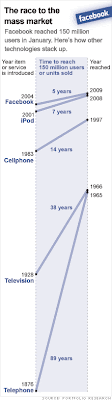
Fortune featured Facebook in an article "How Facebook is taking over our lives" in February 2009. Read the story. The focus was on the growth in Facebook users and race to mass market (Graphic below), stickiness, user demographics, Zuckerberg's vision and applications that make Facebook a very happening place!

Here is Paul Monica, (editor in chief of CNN money) critique of Facebook published as "Why i hate Facebook".


Reason 1: It is not always about Networking. There are times when people like to be un-networked.


Reason 2: With 175 million users and growing at 6 million per month, the top line sounds great. But How do you generate meaningful revenue and profits out of such a venture/user base. Popularity @ Freetardonomics is fine, but profits are cooler!


Reason 3: The first 150 million users accrued to the following in the stated number of years.
Telephone: 89 years
Television: 38 years
Cellphone: 14 years
iPod: 7 years
Facebook: 5 years
This rationale has a strong fallacy: Apple sold a product to 150 million consumers, a pretty pricey one at that where as all Facebook has done is to get people signed up for a service: a free one at that. A comment worth a mention in here is "Bill Gates did not become one of the wealthiest men on the planet by giving away operating systems for free!"

Reason 4: Social networking is about easily connecting and communicating with friends. Ads and promos wouldnot mean much to the user who is "blind" to all that the web site offers since he is single mindedly networking. Thus the inherently loose one here is that Social Websites can never be major generators of Ad revenue.

Reason 5: Efforts to tap information about users implicitely can invite legal backlash as it did with the Beacon@Facebook. This furthermore narrows the field for targetting users with relevant marketing stuff.

Reason 6: 2009 and 2010 would possibly be the toughest years in US and marketers will cut costs. Online advertising will slow down from 17,5% in 2008 to 8.9%. Facebook's attempts at Traditional online advertising has failed miserably and revenue from banner ads are small enough to ignore them as incidentals.

There are the examples of AOL and Yahoo who after a brilliant start fizzled out in trying to monetize their offerings on the web. Facebook and its team must now deliver on a telling agenda of monetizing their growth on a difficult wicket of the economic meltdown.

Saturday, March 14, 2009

Mobile Operating systems by market share

Source: Garner Press releases.
In the smartphone space in 2009, mobile platforms will be a major battleground as the associated user experience and the role of the ecosystem grows in importance. The best example of this is the 25000 applications mark and the 500 million application download for the Apple iPhone Apps stores. Presently, RIM, Microsoft, Nokia, Palm are in the race to their own versions of Apps store.
The Operating systems market is now witnessing a shift from a Symbian dominated construct to a more even distribution (even though Symbian is miles ahead of its competitors in terms of size and share). Symbian's fall has coincided with the fall of Nokia's smartphone market share and the rise of the challengers such as RIM, Apple's OS X and Linux based Android. Symbian has been the last in terms of operating systems that has riden the touch device smartphone wave. Apple's OS X, has taken 10.7% of the OS market shares post its debut in 1Q,2007. Similarly RIM has gained 10% Market share points in 2007 - 08 (8 quarters). Palm has fallen sequentially and the launch of Palm OS sometime this would be eagerly watched in terms of Palm's recovery from 1% share. Microsoft has kept with the market by featuring in the Samsung and HTC smartphones. 2009 will also be important in terms of Linux's growth. Not only are more Android devices in the pipeline but also Open source is finding gaining in relevance and acceptance.
In terms of growth vis'-a-vis the market, RIM and Microsoft have grown by 257% and 60% respectively in the last 8 quarters (against market growth of 53%). Symbian has clocked a 13% growth in 8 quarters! In terms of Numbers, Symbian's 17% loss of market share can be squarely attributed to OS X and RIM.

Friday, March 13, 2009

Mobile Banking: The Future

Check out this SlideShare Presentation, which lucidly explains the concept of mobile banking, expains the dimensions and provide a good refernce point.

Guardian Open Platform: The launch

An addendum to my earlier blog post about Guardian's Open Platform initiative. http://technologyandtelecom.blogspot.com/2009/03/harnessing-open-source-to-power-next.html