Sunday, March 15, 2009

Profiling Facebook: The Google of Social Networking (Part III)

http://technologyandtelecom.blogspot.com/2009/02/profiling-facebook-google-of-social.html
This is the last of the Profiling facebook series. The earlier posts have been listed above. The first post dealt with the rise of Facebook and its business model, the second part dealt with Mark Zuckerberg's vision for Facebook. This post is a critique of the Facebook's success in terms of efforts @ monetization of Social Networking Freetardonomics.
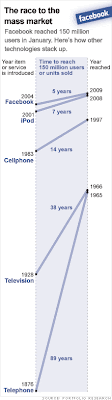
Fortune featured Facebook in an article "How Facebook is taking over our lives" in February 2009. Read the story. The focus was on the growth in Facebook users and race to mass market (Graphic below), stickiness, user demographics, Zuckerberg's vision and applications that make Facebook a very happening place!
Here is Paul Monica, (editor in chief of CNN money) critique of Facebook published as "Why i hate Facebook".


Reason 1: It is not always about Networking. There are times when people like to be un-networked.


Reason 2: With 175 million users and growing at 6 million per month, the top line sounds great. But How do you generate meaningful revenue and profits out of such a venture/user base. Popularity @ Freetardonomics is fine, but profits are cooler!


Reason 3: The first 150 million users accrued to the following in the stated number of years.
Telephone: 89 years
Television: 38 years
Cellphone: 14 years
iPod: 7 years
Facebook: 5 years
This rationale has a strong fallacy: Apple sold a product to 150 million consumers, a pretty pricey one at that where as all Facebook has done is to get people signed up for a service: a free one at that. A comment worth a mention in here is "Bill Gates did not become one of the wealthiest men on the planet by giving away operating systems for free!"

Reason 4: Social networking is about easily connecting and communicating with friends. Ads and promos wouldnot mean much to the user who is "blind" to all that the web site offers since he is single mindedly networking. Thus the inherently loose one here is that Social Websites can never be major generators of Ad revenue.

Reason 5: Efforts to tap information about users implicitely can invite legal backlash as it did with the Beacon@Facebook. This furthermore narrows the field for targetting users with relevant marketing stuff.

Reason 6: 2009 and 2010 would possibly be the toughest years in US and marketers will cut costs. Online advertising will slow down from 17,5% in 2008 to 8.9%. Facebook's attempts at Traditional online advertising has failed miserably and revenue from banner ads are small enough to ignore them as incidentals.

There are the examples of AOL and Yahoo who after a brilliant start fizzled out in trying to monetize their offerings on the web. Facebook and its team must now deliver on a telling agenda of monetizing their growth on a difficult wicket of the economic meltdown.

Saturday, March 14, 2009

Mobile Operating systems by market share

Source: Garner Press releases.
In the smartphone space in 2009, mobile platforms will be a major battleground as the associated user experience and the role of the ecosystem grows in importance. The best example of this is the 25000 applications mark and the 500 million application download for the Apple iPhone Apps stores. Presently, RIM, Microsoft, Nokia, Palm are in the race to their own versions of Apps store.
The Operating systems market is now witnessing a shift from a Symbian dominated construct to a more even distribution (even though Symbian is miles ahead of its competitors in terms of size and share). Symbian's fall has coincided with the fall of Nokia's smartphone market share and the rise of the challengers such as RIM, Apple's OS X and Linux based Android. Symbian has been the last in terms of operating systems that has riden the touch device smartphone wave. Apple's OS X, has taken 10.7% of the OS market shares post its debut in 1Q,2007. Similarly RIM has gained 10% Market share points in 2007 - 08 (8 quarters). Palm has fallen sequentially and the launch of Palm OS sometime this would be eagerly watched in terms of Palm's recovery from 1% share. Microsoft has kept with the market by featuring in the Samsung and HTC smartphones. 2009 will also be important in terms of Linux's growth. Not only are more Android devices in the pipeline but also Open source is finding gaining in relevance and acceptance.
In terms of growth vis'-a-vis the market, RIM and Microsoft have grown by 257% and 60% respectively in the last 8 quarters (against market growth of 53%). Symbian has clocked a 13% growth in 8 quarters! In terms of Numbers, Symbian's 17% loss of market share can be squarely attributed to OS X and RIM.

Friday, March 13, 2009

Mobile Banking: The Future

Check out this SlideShare Presentation, which lucidly explains the concept of mobile banking, expains the dimensions and provide a good refernce point.

Guardian Open Platform: The launch

An addendum to my earlier blog post about Guardian's Open Platform initiative. http://technologyandtelecom.blogspot.com/2009/03/harnessing-open-source-to-power-next.html

Thursday, March 12, 2009

Storm-controlled Formula One car a hit with Lewis Hamilton

Storm-controlled Formula One car a hit with Lewis Hamilton

Compelling video featuring the Blackberry and Accelerometer being used to run a Formula one Car (the real mcCoy with Lewis Hamilton steering the accelerometer and the McLaren Car). I am reminded of james Bond (Pierce Brosnan) using such a gadget in the Tomorrow never dies to the disapproval of Q, the gadget maker.

Posted using ShareThis

Smartphone Market Share Update

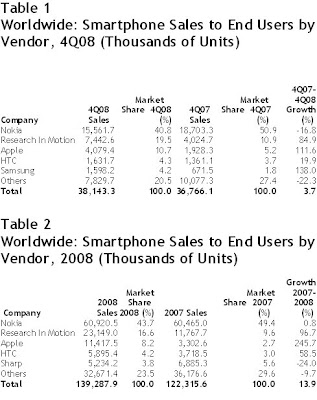
The fourth quarter of 2008 saw Smartphone sales growth rate dip to 3.7% (versus 4Q,2007). The report compiled by Gartner, says that the worldwide sales of Gartner reached 38.1 million units, and slowed down considerably due to the fewer compelling devices and a worsened economic climate. Sales in 4Q were marginally better than the Q3, 2008 number of 36.51 million. As a proportion of all mobile device sales, Smartphones bettered the 4Q, 2007 number of 11% by 1 percentage point i.e 12%.
Global sales of smartphones reached 139.3 million units for the year 2008, which betters 2007's smartphone sales (122.3 million units) by 13.9%!

The iconic Apple iPhone doubled its market share from 5.2% to 10.7%. It sold 4.1 Million iPhone against a 1.9 million number in 4Q, 2007. http://www.electronista.com/articles/09/03/11/gartner.on.q4.2008.sphones/. The buzz around this device is almost unreal, with Operators rooting for it. AT&T (Read Article) has declared iPhone 3G a success after the inroduction of the Iphone served as a catalyst for a shift towards data on its networks. It has reported a 51.2% jump YOY renue from data usage on its networks. For the full year of 2008, iPhone has reported a 245% jump in units shipped (3.3 Million in 2007 and 11.4 Million units in 2008). Canadian based Telco Rogers, has also reported 36% boost to its data revenues because of iPhone in its portfolio. iPhone now contributes 33% to Roger's Smartphone sales. (Read Article)
Boosted by the Blackberry Bold and the Storm, RIM's market shares went from 10.9% in 4Q 2007 to 19.5% in 4Q,2008. It registered a 85% growth in number of units from 4 million in 4Q,2007 to 7.4 million in 4Q,2008. Over the full year, RIM bettered its 11.6 Million sales number in 2007 to 23.1 Million in 2008 (a jump of 97%).

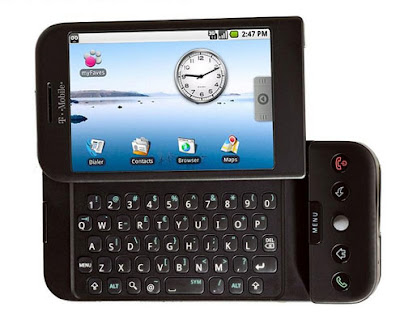
The T-mobile G1, the first Android operating system powered mobile, and the Touch Diamond helped HTC better its sales from 1.3 million (4Q,2007) to 1.6 million(4Q,2008), a jump of 20%.

Samsung's Omnia and its other touchscreen devices have finally led its break through into the top 5, displacing Sharp. Samsung registered a 138% growth in 4Q,2008 over 4Q,2007 taking its Smartphone number from .67 million to 1.6 million!

The looser for a while and this time as well, is Nokia, who has lost 10% market share in smartphones (from50.9% to 40.8%). While it is still the market leader by a mile, Nokia was the only compnay in the top 5 to have registered negative growth of 17% (from 18.7 million in 4Q,2007 to 15.56 million in 4Q,2008). On a year basis, Nokia stagnated and registered .8%growth in a market which grew 13%. Its full year market share reduced from 49.4% (in 2007) to 43.7% (in 2008). The numbers shipped were 60 million in both years.

Tuesday, March 10, 2009

Harnessing Open Source to power the next level of Business: The Guardian's Open Platform initiative


In the age of open source and democratization of content it is just time before newspapers and news agencies join the open platform and social networking as a means to stay relevant. The challenge is to customize the business model around these to make money even while they reinvent the rules of the game. Guradin, The UK based newpaper has taken its first step in this direction by launching what they call the "Open Platform". While all newspapers have a blogs, content and online presence, Guradian's venture is different.
What guardian plans is to open up millions of of pieces of content: Stories, Photos, Slideshows and data sets to all who want to process all this data through web applications and mashups etc. In its present avataar, all this is Guradian's core product, which Guardian shall open up to the internet for free! Why would someone do that?
Three reasons:
1. Guardian plans to use this channel to push advertising. In effect, by being a host to users, developers and applications, it is creating a captive base and it will push advertising feeds into this outlet as well. This thus becomes an extremely scalable way to increase ad inventories and at some stage Guardin will venture out into targetted advertising through API (application programming interface). That like creating a new G Mail and adsense.

2. Opening up all its content inventory would attract a whole bunch of programmers and developers to this platform which would nurture innovations around the core product. In an age where news feeds are so commoditized, innovations from an open source can pep up the channel offering. All this development at zero cost. Developers have already started throwing up interesting results. API maps matches news content with locations aroudn the world to create a crowd sourced geo tagged database of news. Content Tagger allows users to create web tag on Guardian database.

3. If nothing else works out, the effort is going to create branded content and applications, at no incremental cost. With no incremental costs again, Guardian will probably create plenty of new consumers and a new level of brand awareness.
All in all, an interesting piece of work, which would give us reasons and ideas on what works and what doesnot in terms of Monetizing efforts around the social networking platform in this age of Web 2.0 and Freetardonomics.