Thursday, July 30, 2009

Indian Telecom Story (Part XV): Net operating margins at Risk

An extension of an earlier post, which has discussed the problem of reducing operating margins for Telecom Operators in India in the of falling ARPUs and high operating expenditures; this post profiles the predicament for Airtel. If Airtel being such an established player in the market is facing a crunch in its operating margins, the performances of other marginal players and new comers could be under serious doubt!


Airtel registered a 17% YOY revenue increase. However, its quarterly sequential revenue growth seems to be tapping out at 1.19%. Thus the revenue growth is slowing down. Net profit is up 26% but that is mainly because of lower financial costs and spends. Operating profit margins are reduced from 30% in last year to 27% this year.


The concern for Airtel is that the growth in number of subscribers is hitting a plateau. With more competitors, the subscriber figures growth may actually dip. The ARPU has decreased 20.6% YOY. With both these numbers going south, it would be difficult for Airtel to keep up its performance in the next few quarters.
Applying the same analogy to other operators and the new comers, one would expect some congruence in the statuses. The overall market situation is same in all cases and thus the performances would not be very different for other operators. It is in this context one needs to evaluate the price discounting options that the new operators are resorting to. It may be a short cut to establishing a quick base but sustainability and profitability are very big questions. Couple that with the high initial spends of getting a toe hold in the market, the break even seems to be distant. Ask Virgin Mobile for validation.

Is it R.I.P Moore's Law? Big Blue doesnot think so!

Moore’s Law is named after Intel co-founder Gordon Moore, who in 1965 said a silicon chip’s number of transistors, and therefore its processing power, would double every 18 months. The longstanding high-tech principle that processor performance doubles every 18 months came under question last September, when Intel scientist Paul Packan published a paper that stated chip engineers hadn’t found ways around microprocessor design barriers for chips sets to be manufactured after this year. Since then, the Semiconductor Industry Association has predicted that chip performance will continue to increase over the next 15 years, but doubts about the physical limitations of silicon chips remain.
What Gordon said was the model is driven by the cost reductions that are allowed – the science takes the technology into more and more devices and the volume will explode because the cost comes down, so it is an economic model (more than just a scientific model).

Thus it looks as if the industry has reached a threshold point where the cost of making tools required to keep making smaller and smaller components has finally outstripped the ability of vendors to sell them profitably. Hence, is it R.I.P. Moore’s Law?

IBM doesn’t necessarily think it has — Big Blue says other things besides clock speed will work to increase performance.

IBM says it is taking a more holistic approach to its semiconductor research and development. Instead of focusing on clock speed, the company says it is deploying and developing a number of new processor technologies that do the job better.
  1. Alternate technology involves copper interconnects are more power-efficient conductors than the aluminum interconnects currently in wide use, meaning a chip will take less power and run at a lower temperature for the same clock speed.
  2. Another way to increase performance is to improve memory capacity and improve its ability to move more data faster to a processor. IBM this week announced new memory technology that increases the amount of data that can be stored in a memory chip. Lange said IBM has developed a way to break a memory density barrier — or SF82 (squared) barrier — by finding a way to completely immerse the memory trench, that part of its memory chip that stores data bits, in silicon and shrinking the size of the trench.
  3. Increasing memory capacity by making memory cell components smaller and increasing the amount that can be stored in a single chip makes it possible for IBM to build processors with larger amounts of integrated memory. Integrated memory cuts processing time because the chip can fetch data from close at hand, rather than having to reach out to the main memory of a system across a much slower bus. Bus speeds are lagging processor speeds by factors of four or five, a gap that isn’t likely to close any time soon.
  4. IBM is also working on improving network efficiency by implementing network processors, which it says can analyze data more quickly, for devices such as routers. These check the contents and destinations of packets through specially designed circuits rather than software, improving effectiveness, speed and reliability.
  5. In terms of advances that do directly affect pure clock speed, meanwhile, Lange said Big Blue has developed chips with features as close together as 0.05 microns in its labs.
  6. The current industry standard is 0.18 microns and will move to 0.13 microns next year and 0.10 microns in about 2003.

Ref:http://news.zdnet.co.uk/hardware/0,1000000091,2076881,00.htm; http://industry.bnet.com/technology/10002761/moores-law-reaching-statute-of-limitations/

No Future for Apps Stores? Web browsers is the way to go?

Apple customers may have downloaded 1.5bn applications from its AppStore in the past year for their iPhones and iPod touches, but the service does not represent the future for the mobile industry, according to Google. Vic Gundotra, Google Engineering vice president and developer evangelist, maintains that the web would win and users of mobile phones would get their information and entertainment from browsers in future. The case in favour of web based browsers is the lack of platform uniformity. Having different support for all of the different mobile platforms from Apple’s AppStore to those of the BlackBerry, Windows Mobile, Android and the many variations of the Nokia platform is nightmarish.

Google forecasts a move to incredibly powerful browsers, which would be platform independent. A vast number of applications can be delivered through the browser and there are huge cost savings by shifting to a single browser window from individual company based platforms.
Quoting Gundotra, “We believe the web has won and over the next several years, the browser, for economic reasons almost, will become the platform that matters and certainly that’s where Google is investing.”

Advances in the browser being introduced through HTML5 standards meant that web applications could tap features of particular phones such as their accelerometers. An example is Safari Webkit-based browser on the iPhone allowed positioning technology on the phone to be used and Google’s home page can now display where users are located. Webkit, which Apple had turned into an open-source project, was also powering the browsers on the Android and Palm operating systems.

While Steve Jobs had hinted two years earlier at open source development of a common platform. The timing then was not right. The rate of innovation in the browser [over the past 12 months] is surprising. Steve Jobs really did understand that, over the long term, it would be the web, and it looss like that is how things will play out.

http://www.mobithinking.com/blog/no-future-for-app-stores

http://blogs.ft.com/techblog/2009/07/app-stores-are-not-the-future-says-google/

Google's effort at offsetting Carbon

Google logo on search on the day of Solar eclipse (22nd July 2009)

Only a few days back, I had posted a blog on Yahoo’s efforts for Carbon off setting. http://ronnie05.wordpress.com/2009/07/20/9834/. Google is also following suit in terms of efforts to neutralize carbon footprint.


Ambient Cooling is one of the approaches highlighted in the article http://www.reuters.com/article/gwmTechnology/idUS338804957820090722. In its Belgium data centre, rather than using internal air-conditioning for cooling the hardware, the company is relying on the normally low atmospheric temperatures to provide all the free cooling its servers need. The climate in Belgium will support free cooling almost year-round, according to Google engineers, with temperatures rising above the acceptable range for free cooling about seven days per year on average. The average temperature in Brussels during summer reaches 66 to 71 degrees, while Google maintains its data centers at temperatures above 80 degrees. On days, when the atmospheric temperature is above the data centers temperature, Google will turn off equipment as needed in Belgium and shift computing load to other data centers.This approach is made possible by the scope of the company’s global network of data centers, which provide the ability to shift an entire data center’s workload to other facilities. As a result of its use of outside-air for cooling the data center, Google will save tens if not hundreds of thousands of dollars in cooling costs, while also cutting back on the greenhouse gas emissions tied to the electricity used to run the chillers.

Indian Telecom Story (Part XIV): Can pricing differentiate new Telco services?

Of late, the number of foreign operators who have entered the Indian shores is impressive. Global Operators like MTS, Etisalat, Sistema, Do Co Mo have started offering their services to consumers.

However, what is disappointing is that all of these operators have yet again taken the price route to establish themselves in the market. Sample Tata Do Co Mo in Karnataka/Bangalore for instance. They have innovated on the talk times, charging consumers for seconds of usage instead of minutes of usage. This squarely means that if I make a call for 3 minutes and 20 seconds through the network, Tata Do Co Mo charges me for 200 seconds of usage instead of 4 minutes. That is very good news to the consumer. A rough calculation and analysis of my call minutes showed me that over the last 24 hours or so, I had actually used 2381 call seconds, while my operator would be charging me for 59 minutes/ 2940 seconds of usage. Going by the Minutes of usage concept, I was paying for 10 minutes that I did not use. These were the residual seconds that I was charged for! That is a 19% waste of my money! The seconds of use is thus a terrific value to the consumer. No wonder than that Tata Do Co Mo had signed on 400,000 users in the first week of launch.

Now let’s flip it over from the business perspective. Many of the new entrants have deep pockets and hence are keeping the advertising and media happy with marketing spends. However, a deeper analysis leads me to think that the approach is likely to be very short term. Here are the reasons that I put forth for the same:

  1. Without Pan India presence it is very unlikely that these new entrants will find a lot of business segment consumers (who are typically high value)
  2. Thus these price based promotions will land them with a base of medium of low and medium value consumers.
  3. Even if we assume that this may attract new subscribers to the services, but the ARPUs will not be sustainable and profitable.
  4. Such promotions do not act as differentiators or entry barriers in the long term. It wont be long before Airtel, Vodafone, Reliance and older players follow suit leveling the ground.
  5. If anything, this tactic only serves to lower/break the floor prices of the services.

Lowering the cost of ownership has been extremely successful ploy in terms of expansion of the Indian Telecom markets. The ARPU today is around the theoretical $5 break point. In mature markets an ARPU under $5, does serious harm to the bottom-line. In a growing market like India, the strain of a decreasing ARPU may not be significantly visible presently. However, with markets maturing, the focus will shift from growth to sustainability. The new classes of consumers are mostly rural and their ARPU would be well below $5 (probably $3-3.5). Managing bottom-lines at such low levels of Revenue per user and increasing costs of acquisition will prove to be a challenge.

I had expected a higher degree of service innovation by the new players. I had expected that they we would see some exciting innovations around value delivery. It could have been Internet, VAS or the MVNO based delivery. By playing the price route, the new players seem to be playing it right to the incumbent’s advantage. I have always thought that in absence of compelling value propositions that the consumer is willing to pay a premium for, it is always cost that the consumers fall back upon. It seems that branded value services are one of the most obvious businesses that the current Telcos are missing to capitalize. Lets then wait for the discontinuity from the current price based business model to value based ones!

Apple: What Next?

Apple’s Q3 results have been very good! The thought is that this is Apple’s brightest hour and having hit the peak, there is no way but a gradual slide down. However there is more in the communication from Apple on how they let their own products cannibalize themselves and how they are innovating the future! Apple COO stops short of naming iTablet as the next from Apple Stable

Ref: http://online.wsj.com/article/SB124820913514969595.html; http://online.wsj.com/article/SB124821056118269783.html; http://blogs.wsj.com/digits/2009/07/21/live-blogging-apple-earnings-2/

Apple has been heaped with praises for its non-conformist strategy and super-hit portfolio of products which have upstaged the industry incumbents. The Q3 results declared this week have been Apple’s moment in history! Third-quarter sales rose to $8.34 billion, up from $7.46 billion a year ago, due in part to strong sales of the iPhone. Net income rose to $1.23 billion, up from $1.07 billion. Apple’s growth of 4% with IDC forecasting negative 3 percent and Gartner forecasting a negative 5 percent, puts them 7-9 points ahead of the market.
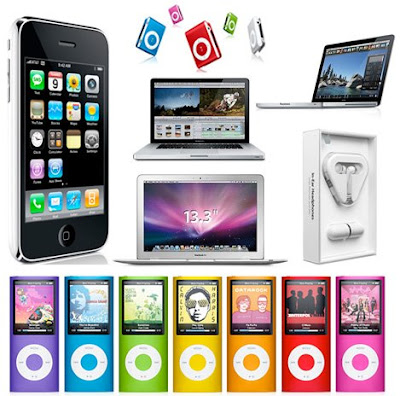


  1. Response to the new iPhone 3GS has been tremendous with over 1 million sold by the third day after its June 19th launch. Apple goes on record saying that they are currently unable to make enough iPhone 3GSs to meet demand and are working to address that.

  2. Apple registered outstanding sales of 2.6 million Macs setting a new June quarter record and nearly meeting the all time quarterly record.

  3. Apple sold 10.2 million iPods which was down from 11 million in the year ago quarter. There were two key reasons for this decline: First, we reduced channel inventory by over 400,000. Second, sales declined by 4% year-over-year.

  4. The iTunes store delivered another great quarter fueled by strong sales of music, video and apps.

  5. Apple retail stores hosted 38.6 million visitors during the quarter compared to 31.7 million visitors in the year-ago quarter –an increase of 22%.

  6. Apple’s app store has more than 65,000 apps, compared with 1,000 to 2,000 at the Nokia store. Apple thus has a substantial lead on apps.

There were a few significant announcements during the earnings call, which warrant attention.

The first point
The iPod growth story now appears to be tapping off. Shipments of iPods fell 7% from the first quarter to second. And iPod ASPs also declined, despite the growth of the more expensive iPod Touch.

Revenues from selling Mac computers actually fell 8% last quarter compared to a year ago. The company sold 4% more Macs than it did in the same period last year, at a lower price point.
Macs and iPods are slowing down and may be entering the declining plateau stage of their life cycles! Apple would have seen this coming, and the $99 iPhone would be cannibalizing the iPods, by design.

Secondly, if you read between the lines of Timothy Cook’s message, it appears that Apple has a trick up its sleeve. Quoting Apple COO, Timothy Cook

“I think some of the netbooks that are being delivered, or many of them, are very slow. They have software technology that is old. They don’t have a robust computing experience. They lack horse power. They have small displays and cramped key boards.”

Is this what Apple is going to spring upon Netbook manufacturers?

The invective makes you think that while Apple rails against the existing Netbook makers, may be, it has a net-book product that it plans to launch soon! Is this the Apple heralding its iTablet.

A study in contrast: Apple and Nokia

The numbers do justice to the sentiment towards both these companies at this time. Apple is clearly shinning bright and is the toast of the bourses.

Ref: http://online.wsj.com/article/SB124821056118269783.html; http://www.apple.com/pr/library/2009/07/21results.html; http://online.wsj.com/article/SB124820913514969595.html; http://industry.bnet.com/technology/10002677/can-anyone-out-app-apple/

Even the staunchest critic would not count out Nokia but it surely seems that Nokia has lost its way in the Smartphone race and needs to retrospect its strategies and approach to user experience. N 97, which was being touted as the most advanced multimedia computer has failed to impress and unless, one is die hard Symbian S60 fan, there is very little reason one would opt for the N 97. With no other significant touch screens from Nokia at the moment, there is nothing that customers and investors are looking forward to from Nokia.

http://gizmodo.com/5308440/nokia-n97-review-nokia-is-doomed

The rumour mills are running abuzz with the theory that Nokia would do well to acquire Palm because palm offers Nokia all that it really needs desperately at this point of time. http://www.ubergizmo.com/15/archives/2007/03/nokia_possibly_interested_in_palm.html

Even LG, which doesnot feature as a serious contender in the smartphone business seems to be getting its acts right in that market. http://www.forbes.com/2009/07/22/lg-nokia-sony-markets-equity-technology.html?partner=msn

Nokia seems to be walking the path of Motorola 3 years back. http://www.forbes.com/2009/07/17/nokia-apple-iphone-markets-equity-mobile.html?feed=rss_technology

It’s been a heck of a ride for Apple investors. The stock, which has nearly doubled so far this year and over the past five years the stock has gained an average of 56% a year, an extraordinary achievement. It cannot keep its supply commitments for iPhone. It has already sold 7 times the number of iPhones this year as it did last year. In a extremely competitive smartphone market, Apple is using all its legs to score above the competition: Its Device, the software/UI/Browser and the Applications! Interesting to see how Apple would get the most of this now…