Wednesday, June 17, 2009

Blackberry: Ruling the US smartphone market


On RIM and Blackberry steady rise in Smartphones in US and world markets. The reasons for its performance are its competitive pricing, availability across carriers, business expertise (security, service and reliability for enterprise users), aggressive pricing and portfolio. This article also reviews the weaknesses in the RIM portfolio where it would need to work hard and work quick so not to loose edge to the sharp competition.
Resource:CNNMoney.com

Apple's iPhone 3GS and Palm's Pre has captured a lot of hype but don't count out Research in Motion's BlackBerry just yet, say experts.
While the iPhone enjoyed an initial pop in market share after the second generation version was released last July, that share has been nearly cut in half.
In the first quarter of this year, BlackBerrys had a 55.3% share, compared to 19.5% for iPhones, according to IDC data. Compare that with the third quarter of 2008, when BlackBerry devices controlled 40.4% of the U.S. smartphone market, compared with 30.1% for Apple.
Solid footing. Much of RIM's anticipated success lies in its ability to grow market share even as competitors launch new flashy devices.
Analysts expect that market share to grow into next year, despite the mostly negative reviews for its first touchscreen device, the Storm, and new launches from Apple and Palm.
A recent Yankee Group survey showed 41% of Americans plan on buying a smartphone for their next phone purchase, and 50% of those people plan on buying a BlackBerry. Only 25% said they would buy an iPhone.
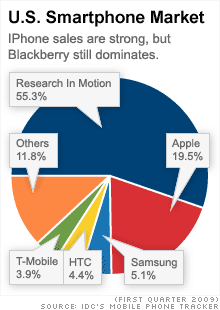
Experts cite competitive pricing, business expertise and new consumer products as reasons for RIM's sustained growth.
Pricing. RIM may not offer the interactive operating system experience that the iPhone, Pre or Google's G1 phone offer, but RIM offers BlackBerrys that beat them in end user cost.
That's because every major U.S. wireless carrier offers at least one BlackBerry device, unlike competitors, which have exclusive contracts with AT&T, Sprint and T-Mobile. With the carriers fighting for customers, many offer discounted rates, including Verizon's aggressive "buy one get one free" promotion for its BlackBerry line.
Analysts say wireless providers can afford to offer competitive pricing because BlackBerrys cost less for them to operate than iPhones and Pres.
"RIM's design is much more bandwidth-efficient than its competitors, so carriers make the most money off the BlackBerry platform," said Nick Agostino, RIM analyst with Research Capital Corp. "Once two carriers in the same market offer BlackBerrys, they start to compete against one another and RIM is the beneficiary."
The campaign appears to be working. Exclusive iPhone carrier AT&T has as many BlackBerry users as iPhone users, according to Andy Castonguay, director of mobile device research at Yankee Group.
"The total value of a device goes far beyond the physical phone itself," said Castonguay. "Service, reliability and functionality all play a part in the total valuation, and BlackBerry continues to distinguish itself in those terms."
Enterprise. Most experts agree that RIM has solidified its standing at the business smartphone of choice, due to its focus on security and ease of configuration.
"RIM has been very aggressive in its enterprise server upgrades, making its software even more appealing to businesses," said Castonguay. "RIM has made a name for itself in security, service and reliability, which are fundamental necessities for companies."
Still, some think that RIM shouldn't get too comfortable as the enterprise leader.
"RIM is facing bigger challenges now from a competitive standpoint than they've ever had before," said Ken Dulaney, analyst at tech consultancy firm Gartner. "The user interface doesn't match up to its competitors, and many of our clients are breaking with their previous policies just to use the iPhone. IT departments are beginning to support anything with basic security features."
Furthermore, the company still has some ground to make up in worldwide smartphone sales. It controls just 20% of the global market, compared to 41.2% for Nokia.
The company is trying to broaden its appeal to global businesses, including world travelers with its new BlackBerry Tour, which can easily access foreign voice and data networks while abroad.
What's in store. BlackBerry has increased its consumer base in the past three quarters, according to IDC, but some analysts think RIM needs to establish itself as more a consumer device.
The launch of the BlackBerry app store has helped draw consumers, experts say, and though it lags behind the iTunes app store, it has grown to become the No. 2 app store. The Pearl and Curve have also sold well, and the Storm held its own after heavy subsidies from Verizon.
But most analysts agree that RIM will need to launch a competitor that looks and functions more like the Pre to continue to drive consumer demand. Both Verizon and RIM have hinted at a release of a touch screen device with a keyboard in the third quarter of 2009.
"The Pre and iPhone pushed the envelope in what the operating system needs to be in terms of flexibility and ease of use," said Castonguay. "BlackBerry will have to adapt its operating system to become much more consumer-friendly."

Who needs (or wants) another search engine?

VERSUS


Microsoft’s quest for search excellence now has a name: Bing and, whether Ballmer and Co like it or not there are parallels drawn between Google and Bing. Ballmer has made an attempt to consciously avoid pitting Bing directly against the god of search, however, on a competitive aspect, the comparisons are inevitable and unavoidable. Two smart things, that Microsoft (MS) has done with Bing is:
Position itself as a decision engine (rather than a search engine) à Meaning it provides results rather than search query results.
Unlike MSN and Live Search, MS has committed $100 million to marketing the product.

But introducing Bing didn't answer the most relevant question: Who needs (or wants) another search engine?
The only real answer for that question would be to provide a search engine that would actually be worthy of using instead of Google -- one that would be so compelling that we'd want to change our habits to use it.
Bing isn't that search engine. It's just another nice Web site. If it wasn't Microsoft that was launching it, one would probably never even hear of it. Not because it doesn't have good ideas. It's just not earth shattering -- and that's what it would take for most people to break their Google habits. Although Microsoft is positioning Bing as a decision engine, it actually plays like a bunch of individual applications, each with interfaces that are together and sometimes look and feel similar. Moreover, a lot of these features are reminiscent of other websites/platforms.
When you scroll over a result on Bing, it displays a shape to its right. Hover your cursor over that shape to see a preview of what's on the page behind the link. It's a lot like the images that ask.com and those look-ahead browsers that predated Internet Explorer and Firefox. The maps section has all the same capabilities as Google maps or Mapquest but feels faster and displays the info in a slightly different way. Breaking down the results according to category, is much like Vivismo's Clusty search engine. But it doesn't do as good a job of categorizing as Clusty. A lot of other browsing /navigation capabilities at Bing are very inspired from other websites (example: Kayak.com for travel links etc).
Thus with no definitive features or interface that define it to be radically different from the existing stuff available on the net, MS is merely putting together few different things together on the same website. With the fierce pace at which Google is innovating presently, MS needs to relook the paradigm. Presently MS is re-packaging stuff. But to out do Google, one would need to out innovate them. Looks like MS is not doing much of that.

Monday, June 15, 2009

Indian Telecom Story (Part IX): 400 not out

In the newest release of subscriber figures by TRAI, 11.90 Million users were added in April 2009 as against 15.64 million in March 2009.The number of mobile subscribers in India crossed the 400 million mark in April, putting the country on track to reach its goal of 500 million customers by next year. The rise took India’s total wireless subscriber base to 403.66 million, TRAI said. The slowdown in subscriber growth came after cellular operators withdrew special deals on offer during the final months of the fiscal year to March when the firms sought to boost revenues to help their annual accounts.
But India remains the world’s fastest-growing mobile market and analysts say the government’s target of 500 million mobile phone users could be reached ahead of schedule.The total telecom subscriber base made up of wireless and landline customers stood at 441.47 million at the end of April compared with 429.72 million in March, TRAI added.Total penetration stands at close to 38 telephones for every 100 people, TRAI said.

3G Deployments
India has said it will stage its much delayed auction of third-generation (3G) wireless spectrum by year end.Third-generation wireless service allows voice, data and video to be sent at high speeds to mobile devices and is viewed as the next major booster driving growth in India’s telecoms market.The Congress-led government had forecast the auction could raise Rs400 billion rupees ($8.5 billion).
But since its re-election last month, it has backed off that forecast, saying the global financial crisis could reduce the windfall.India’s newly reappointed telecoms minister A. Raja has also said he will seek to push cheap local mobile call rates even lower to spur cellular growth.
Local mobile calls now cost as little as one cent a minute while long-distance rates vary from two cents to four cents a minute.Raja says he wants to cut the local rate to less than half a cent a minute

Worldwide Mobile and Smart Phone Sales: Q1, 2009 Company and OS updates

Source: Gartner

Continued from earlier Post:http://technologyandtelecom.blogspot.com/2009/06/worldwide-mobile-and-smart-phone-sales.html

Reference/ 2008 Market share archives:
http://technologyandtelecom.blogspot.com/2009/03/mobile-operating-systems-by-market.html
http://technologyandtelecom.blogspot.com/2009/03/smartphone-market-share-update.html
http://technologyandtelecom.blogspot.com/2009/01/how-nokia-blinked-in-america-classic.html
http://technologyandtelecom.blogspot.com/2009/03/smartphone-market-share-update.html


1.Nokia continued to lead the mobile phone market, but its share dropped to 36.2 per cent from 39.1 per cent in the first quarter of 2008
2.Samsung retained second place and improved its market share as its sales totalled 51.4 million units.
3.After dropping to the fifth position in the fourth quarter of 2008, Motorola overtook Sony Ericsson to regain fourth place.

4.Positive performance by Research In Motion (RIM) and Apple showed that services and applications are now instrumental to smartphones’ success.
5.Much of the smartphone growth during the first quarter of 2009 was driven by touchscreen products, both in mid-tier and high-end devices.
6.“’Touch for the sake of touch’ was enough of a driver in the midtier space, but tighter integration with applications and services around music, mobile e-mail, and Internet browsing made the difference at the high end of the market.”
7.Symbian accounted for 49.3 per cent of worldwide smartphone operating systems (OS) market share in the first quarter of 2009, down from 56.9 per cent share in the first quarter of 2008.
RIM’s smartphone OS market share reached 19.9 per cent in the first quarter of 2009, up from 13.3 per cent share in the first quarter of last year.
8.The iPhone OS accounted for 10.8 per cent of the market, up from 5.3 per cent market share in the first quarter of 2008.
9.Nokia’s worldwide sales reached 97.4 million units in the first quarter of 2009, due to reductions in inventory in markets such as Asia/Pacific and Latin America. This was the first time Nokia’s sales dipped below 100 million units since the first quarter of 2007. The real impact of the current market recession was on the average selling price (ASP), which saw an 18 per cent drop year over year. Nokia managed to grow its sales in the smart-phone segment by introducing the Nokia 5800 into more regions.
10.Samsung had a very successful first quarter of 2009. With sales of 51.4 million units, Samsung's market share grew 4.7 percentage points to 19.1 per cent. It returned to double-digit profitability due to a good product mix. Sales of its Omnia, Tocco and Pixon handsets continued to benefit from strong consumer interest in touchscreen devices. The arrival of the Tocco Ultra Edition late in the first quarter of 2009, and the announcement of its first Android-based product, the i7500, will help Samsung in a highly competitive second half of 2009.
11.LG sold 26.5 million units in the first quarter of 2009, growing its market share by 1.9 percentage points year over year. The company benefited from a very strong portfolio of touchscreen, messaging and imaging devices. The new LG Arena device showcases a new user interface that demonstrates a positive focus on improving usability. However, LG’s biggest challenge is to become competitive in the smartphone segment as services and applications become more important to customers.
12.Motorola continued to experience significant difficulties even in its home market, but it had a solid quarter with prepaid operators Boost Mobile and Tracfone. It expects worldwide sales of iDEN handsets to be up 50 per cent in 2009 compared with 2008. These factors will help sustain Motorola until it revamps its portfolio in the fourth quarter of 2009. Motorola has committed to Android not only to revamp its position in the second half of 2009, but also to produce long-term performance improvements. How Motorola will be able to differentiate its offering when so many players in the mobile device market will be delivering Android-based products at the same time will be critical for Motorola.
13.Sony Ericsson lost market share compared both with the fourth quarter of 2008 and the first quarter of 2008, with sales of 14.5 million units. While the recession contributed to this decline, a weak product portfolio was also a factor. The product features that helped Sony Ericsson become one of the world's top vendors — imaging and music — are now too common to serve as a differentiator. Sony Ericsson is late to catch on to the popularity of touchscreen devices and has a limited smartphone portfolio. While its focus on services through Play Now Arena is important, Sony Ericsson needs to ensure its devices include the most desirable applications and features for consumers

Sunday, June 14, 2009

IE-free Windows coming to Europe: Microsoft bows to pressure

Reproduced from http://software.silicon.com/os/0,39024651,39441298,00.htm
Countering pressure from European regulators, Microsoft plans to ship the newest version of its Windows operating system in Europe without its Internet Explorer web browser.
The abrupt reversal comes shortly before the European Commission is due to rule on antitrust charges brought against Microsoft in January, claiming that the world's largest software company abuses its dominant position by bundling its Internet Explorer browser, shielding it from head-to-head competition with rival products.
Until now, Microsoft has claimed that the browser was an integral part of the operating system and should not be pulled out, but it now plans to do that for a European version of Windows 7, due to be rolled out later this year.
Microsoft deputy general counsel, Dave Heiner, said in a blog post on the company's website on Thursday: "Given the pending legal proceeding, we've decided that instead of including Internet Explorer in Windows 7 in Europe, we will offer it separately and on an easy-to-install basis to both computer manufacturers and users."
European regulators, which had suggested Microsoft offer a choice of browsers on its operating system to open up choice for consumers, gave a frosty response.
The European Commission said in a statement reacting to Microsoft's move: "Microsoft has apparently decided to supply retail consumers with a version of Windows without a web browser at all.
"Rather than more choice, Microsoft seems to have chosen to provide less."
The Commission is still weighing whether Microsoft's bundling of the browser has been abusive, and what sanctions to bring as a result. It is still possible that the Commission will force Microsoft to include other browsers with its operating system, a move the company has been determined to avoid.
Microsoft's move could yet be a boon for competing browser makers such as Google, the Mozilla Foundation and Opera Software, whose complaints spurred the European Commission case against Microsoft.
Microsoft's Internet Explorer browser is used for about 60 per cent of global internet traffic, Mozilla's Firefox has about 30 per cent, and Opera is at four per cent, just ahead of Google and Apple's Safari, according to web analytics firm StatCounter.

Saturday, June 13, 2009

Is Bing the sound of search? (Part IV)


Do we need another search Engine?


I have to wonder whether users are really crying out for a new search engine.

The only real answer for that question would be to provide a search engine that would actually be worthy of using instead of Google -- one that would be so compelling that we'd want to change our habits to use it.Bing isn't that search engine. It's just another nice Web site. If it wasn't Microsoft that was launching it, you'd probably never even hear of it. Not because it doesn't have good ideas. It's just not earth shattering -- and that's what it would take for most people to break their Google habits.Although Microsoft is positioning Bing as a decision engine, it actually plays like a bunch of individual applications, each with interfaces that are together and sometimes look and feel similar.

Will $ 80 Million buy Microsoft Traction?
Microsoft will spend $80 million to get us to try its new search engine, to be called "Bing." Could that possibly work? (Well, at least it's not caught in the confusing branding world of "Windows Live" . . .)
Consider.
We all used to use Yahoo or AltaVista until we switched to Google. We stayed with Google because it was better.
Now Google is more than just habit. Google has our IDs, customizes our searches, searches our desktops and our email and delivers neatly integrated Maps, reviews, and video searches. It works. There is every reason to stay and no reason to leave.
But $80 million buys enough impressions to get people to try something new.
For this to make the slightest dent, here's what has to happen.
First, the search has to be better.
Second, the search has to be qualitatively different. Not just better search, but "holy cow this is different." Like it was when you first tried an iPhone, or first saw TiVo. This could be a better way to organize different media. It could mean connecting with social applications. It could mean searches that get better at understanding meaning so we all don't have to think in Boolean logic. Frankly, if I can imagine it, it's not different enough. So it has to blow all of us away.
Third, it has to integrate with everything else, better than Google does.
And finally, it has to work equally well on all browsers, all devices, and all PCs, even Apples and Linux machines.
Thus from what it looks like, Bing will bring in some new features to the game and the search ineterface but even with its $80-100 million moneys on advertising, it will be far before it does something radically different to outmode Google totally. That too at a period of time, when Google itself is innovating so furiously all over. Unless Bing has more to it than we have seen till now, it is destined to the same fate as .NET, Zune and Vista.....

Is Bing the sound of Search? (Part III)


Taking on Google

Talking to the Journal, Mr Ballmer conceded that the new name and new look would not be enough to immediately tip the scales: "To make our 8% grow significantly we don't have to capture the imagination of everybody, but we have to capture the imagination of some. We have to grow our brand equity." It will take years to chase down Google, Mr Ballmer told the paper.

Steve Ballmer also acknowledges: “There is no way to change the whole game in one step.” But search “deserves a good feature war.” And Bing will be rolling out new features as it goes forward. But is it enough to get people to switch? Bing is certainly not a game-changer, but it does cut out a lot of the back and forth that happens with so many searches today. If Bing can help people find what they are looking for faster, it will put pressure on Google to keep advancing the ball as well.

Microsoft's research suggests that up to 60 per cent of queries are not answered by current search engines, and that 50 per cent of all searches are in fact repeats of previous questions. Bing aims to be better at working out what users are really looking for. A search for the website Facebook, for example, would display just one result linking to the site itself, but give users the option of displaying further results about the site.

After a botched up attempt to acquire Yahoo, Bing, it appears to be taking no chances. Ad Age reported the company plans to spend as much as $100 million advertising the search engine.

Mike Nichols, a general manager in the Microsoft search group, said the company isn't banking on beating Google but does want to transform its also-ran search image.'We want to capture a unique position in consumers' minds. They need to know why is it that they should use this product.As opposed to saying, we're a new search engine, we do everything a little bit better than the other guys.'

Matt Rosoff, an analyst for the independent research group Directions on Microsoft, said he thinks Microsoft's search results are usually on a par with Google's and combined with the extensive ad campaign, Microsoft has a chance to increase its share.

In the final part of this post, we would analyze on the Search Market and Google Dominance and whether or not will Bing be able to buy in some Traction.