I had discussed the Mobile Termination charges in an earlier blog http://technologyandtelecom.blogspot.com/2009/02/indian-telecom-story-part-iii-entry.html and this was a month back (9th February 2009). TRAI has finally taken the mid road to the question of Mobile termination charges. Mobile termination charges are basically the per minute charge paid by an operator to another, if a call of the first operator is terminated on the second's network. To that effect, any operator with a national coverage has lesser probability of paying this termination charge because chances are that the call will be terminated on its network owing to its ubiquitous presence. Thus the incumbents could use this as a pricing barrier against newer entrants. The chief beneficiaries of the MTC regime are the 100% footprint operator such as Airtel, Reliance, Vodafone etc. Lobbying for the case of MTC as a means to generate returns to serve their rural expansion, it can be debated that the Lobby had tried to impress TRAi and DoT hard on this subject. On the other hand the new players to the party have clamored that a MTC regime would make it difficult for them to establish a reasonable presence because of the price disparities.
As of today TRAI has slashed the MTC charges from 30 paise per minute to 20 paise per minute there by taking the mid road between these two views. The effects of this:
1. Likely reduction in Revenues for the incumbents
2. A more uniform battle ground for new entrants
3. Lowering of the telephone tarriffs for consumers on roaming
4. ARPUs further reducing on account of roaming charges.
Thus to an open market, reduced prices, commoditized products and more competition, here it is: Jaye Ho!



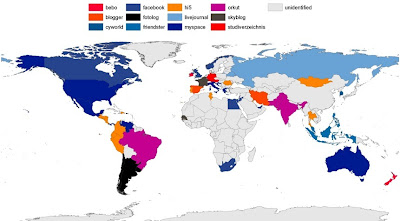 While this schematic is a little old (June 2007) it gives a pretty clear picture of the dominance of social networking websites in the world. The Dark Blue (Facebook) features prominently in Canada, Australia, South Africa, Egypt, UK, Scandinavia, South Korea, Italy and parts of Eurasia. Since then the spread of the Blue would have increased by a factor of 3.5 and would porominently feature the whole North American continent. Facebook's march to 200 million users earnestly began in January 2008, when it made translation tools available to the international user. Today more than 70% Facebook users are outside USA and most of them read it in their native language.
 In 2005, Mark Zuckerberg had outlined his vision for Facebook to be an online "social utility" tool which would mean a global digital phone book which users would use to locate people on the web. In strictest terms the vision has not changed very hugely except that instead of Phone book (assisting medium), facebook intends to usurp the position of the phone itself. He dreams of Facbook to be the central portal for communication, work and pleasure. It also becomes the central place where users organize parties, store pictures, find jobs, watch videos and play games. eventually , Facebook will become an online passkey to gain access to websites and online forums that require personal identification. In other words, Facebook will be the place where people will live their digital lives in the internet of the future.


Dictator Democracy
16 years ago


